

The Truth Behind the H₂OAX
The Truth Behind the Water Lobby’s Big H2OAX
Why All this gamesmanship?
Water lobbyists worked tirelessly to advance the new income tax on water bills to create a massive new government agency, a “UDOT for water” as the study commissioned by Governor Cox’s Division framed it. This agency was to be created by SB 198, which was also run during the 2026 Utah Legislative Session by the senate sponsor of HB 501. The purpose of this agency is to build, own, and manage water projects in Utah, thereby supplanting the role that local water suppliers currently play in planning and building their own water projects.
All this subterfuge and gamesmanship may at first sound hard to believe until one learns of the very costly water projects that this agency — and a range of lobbyists — are eagerly pushing the Utah Legislature to fund. Utahns are eager to protect the Great Salt Lake, but they have been misled into believing the state is not building a massive water project that would devastate the Great Salt Lake even though Governor Cox’s administration is fully advancing this project. This project is called Bear River Development, and it will cost $4+ billion to Utah taxpayers and trigger another billion dollars in dust mitigation spending every year.
This “$1.2 billion annual spending need” claim is nothing less than a Trojan Horse for Bear River Development — the project to divert up to 30% of the Bear River to the lawns of the Wasatch Front. Since the Bear River is the Great Salt Lake’s largest source of surface water, diverting it with this massive water project would devastate the lake. It is physically impossible to restore the Great Salt Lake to a healthy surface area of 1,600 square miles while simultaneously diverting large quantities of water upstream.
In other words, the greatest threat to the Great Salt Lake and life as we know it in Utah is this farcical $1.2 billion annual water spending need claim, the Division of Water Resources, and those behind proposed Bear River Development.
What the Research Reveals
Utah water lobbyists are working hard to tax your water bills, and they justify this new tax by claiming that Utah has a $1.2 billion annual water spending need. They have repeatedly testified to this claim in official legislative committee meetings. To justify this regressive new tax, Utahns need to be shown credible evidence of a real spending need.
It is important to know this $1.2 billion figure is not based on a list of specific water projects or a list of specific infrastructure requiring replacement. In fact, no water infrastructure list exists that documents any shortfalls in revenues to pay for water projects. As taxpayers, if government wants to tax us, it should tell us what the money would be used for by showing us real spending needs. If there is no credible spending need, we should not be taxed.
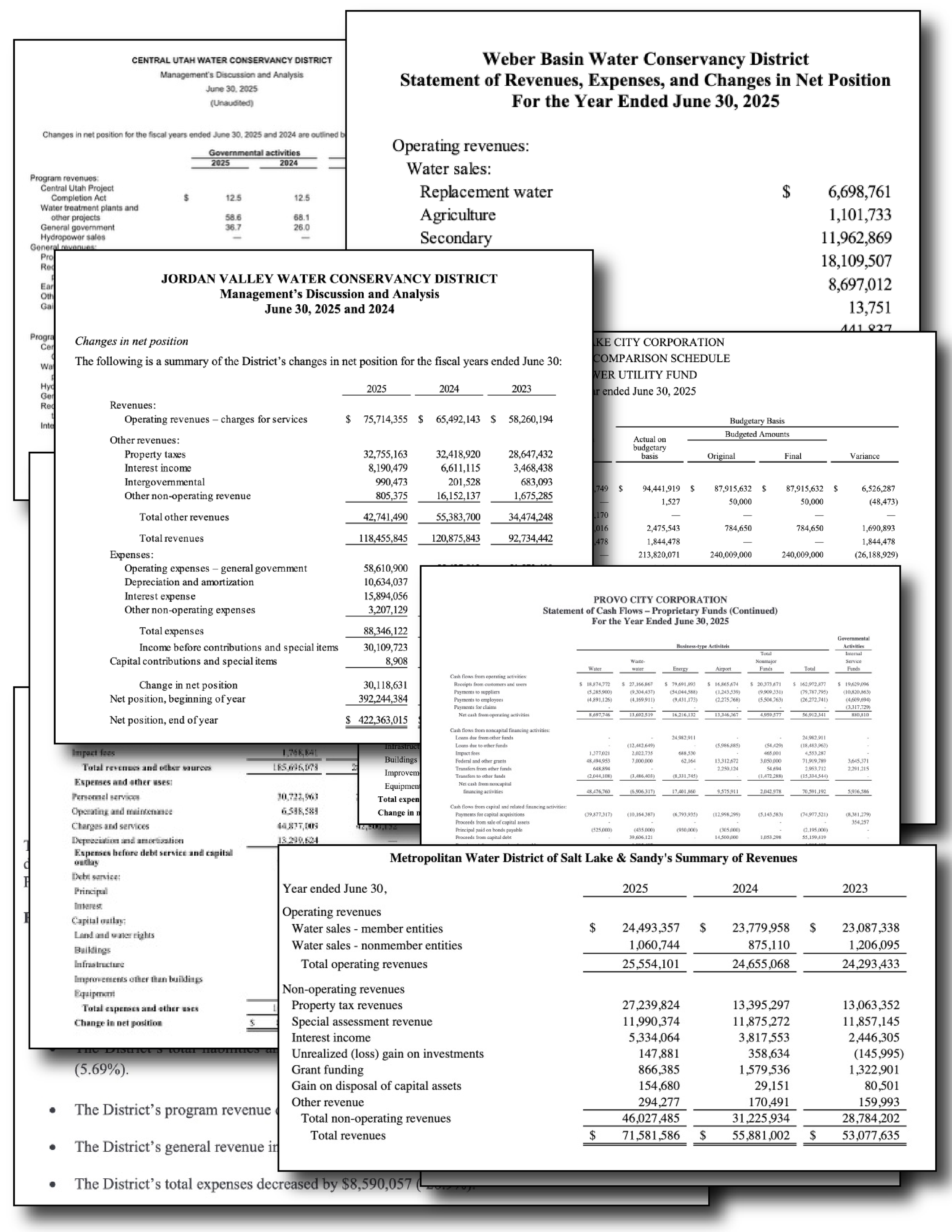
To understand whether this tax on water bills is justified, we exhaustively researched 76 financial statements of Utah water suppliers, including metropolitan water districts, water conservancy districts, improvement districts, and municipal water and sewer departments and agencies. We carefully examined their revenues, expenses and debt from these financial documents. Our findings were disturbing.
We found that this $1.2 billion annual spending need was derived by ignoring ALL revenues currently being collected by all water and sewer providers listed above and only looking at their expenses. That’s right. ALL existing water-related revenues were ignored to manufacture the false impression that we need to tax water bills.
It seems that some government officials are either incompetent at basic finance or they’re trying to pull one over on Utah taxpayers. Because Utah state government clearly needs it, here’s a step-by-step lesson in basic math every grade schooler knows. The following remedial math lesson reveals how they ignored revenues to justify this egregious tax.
How to Calculate the real cost of anything
Step 1: Account for all your income.
Add up every dollar of your income. When accounting for your income, include every dollar you make from your day job and any money you earn from a side gig. Add all these revenues together. The sum is how much money you can use to cover your expenses.
The $1.2 billion H2OAX is based on a purported deficit for all the water and sewer suppliers in Utah. We assembled financial summaries from 76 Utah water and sewer suppliers, which include 22 water conservancy districts, 4 metropolitan water districts, 10 water and sewer improvement districts, and 39 municipal water and sewer funds. According to the financial statements for the most recently available year of data, these Utah water and sewer providers show they collectively earned:
$2.21 billion per year in gross revenues
Utah’s water lobby has either misplaced all of this money or they swept it under the rug so they can squeeze you, your family, and your neighbors for more tax money.
Step 2: Carefully add up your expenses.
Take careful stock of everything you spend money on. Make sure there are no duplicate expenses, make sure you aren’t including anything you’ve already paid for, and eliminate expenditures which aren’t real. Don’t exaggerate expenses, don’t include fabricated costs, and don’t change revenues to expenses to justify spending money. Once you’ve got your expenses down to the necessities, add them together.
On their financial statements for the most recently available year of data, the 76 water and sewer providers we analyzed show they collectively spent:
$1.22 billion per year in gross expenses
Together these expenses amount to $1.2 billion in one year. This number coincides with the $1.2 billion annual water spending need, but we haven’t factored in revenues yet. A real financial need can only be determined after one first considers revenues.
Step 3: Subtract your expenses from your revenues.
Take the gross revenues from Step 1 and subtract the gross expenses from Step 2. If the number is positive, you have a NET income. If it’s negative, you have a net expense.
$2.21 Billion in Revenue (From Step 1)
$1.22 Billion in Expenses (From Step 2)
$986 million
Water and sewer suppliers calculate their yearly debt payments and a few other expenses by deducting from this subtotal. So the net revenues total:
$909 Million in Net Annual Revenues
The net revenue among Utah’s water and sewer suppliers, including sales taxes you pay for water, is $909 million in surplus every year. That’s enough money to buy 3,636 new, top of the line Porsche 911s every single year.

With the net revenues they bring annually, Utah water suppliers could collectively purchase a fleet of 3,152 Porsche 911s each year. The water lobby is hiding all of this revenue.
The basic math above demonstrates that Utah’s water and sewer providers are operating well in the black and have absolutely no need for additional funding through new taxation.
Did we get the Math Wrong?
The financial statements of the 76 Utah water and sewer providers are easy to find because they must be shared with the Utah State Auditor, and with taxpayers, every year. We encourage you to check our work by looking at them yourself.
Keep in mind that this $788 million (not counting $121 million in sales tax for water revenue) in annual surplus revenues ignores the ability of water suppliers to borrow money though bonds, which means this figure ignores their ability to finance projects with funds from bond investors. Water suppliers across the world commonly issue bonds to pay for infrastructure, yet this practice was ignored by Utah’s water lobby in their quest to raise taxes.
That raises an important question. Most of these water suppliers already have debt from borrowing money from bond investors. These bonds have been rated by rating agencies who carefully examined the same audited financial statements we analyzed to give each water agency a bond rating. These ratings determine the cost of borrowing for each water agency.
In their financial statements, these water agencies showcase large surpluses of revenues each year. Of the 76 Utah water and sewer providers we reviewed, we found large net revenues in almost every single agency.
When we added the existing bond debt of all 76 Utah water agencies, we found $3.8 billion in debt that is due in coming decades, some as far out as the year 2073.
If these 76 Utah water agencies really do have a $1.2 billion annual spending need for water, then these financial statements represent potential misstatements or errors that were presented to financial regulators, the public, and the bond market through altered financial statements. We do not believe that is the case.
Alternatively, if these 76 financial statements are correct — which we believe to be the case — then this $1.2 billion annual spending need that has been presented to Utah legislators is incorrect. We need a thorough examination of these claims to get to the bottom of how this H2OAX has gotten this far.
Stay Informed.
Get updates about the campaign to stop the tax.