

Utah’s H₂OAX
hiking Your bill
Some Utah legislators are proposing to tax your water bill with a new income tax based on the average (or median) income in your neighborhood. The mechanics of this tax are explained below.
Supporters claim this tax is needed by pointing to what they claim is a $1.2 billion annual water spending need in Utah. That sounds dramatic and scary, but in truth this imaginary expense raises questions about the role of special interests inside the Utah Legislature.
The Great Salt Lake Waterkeeper of the Utah Rivers Council conducted a comprehensive, six-month-long analysis of 76 Utah water and sewer suppliers’ publicly available financial statements. We carefully researched every source of revenue and accounted for every expense as publicly disclosed in these financial statements.Through this studious analysis, we determined that the $1.2 billion water spending need claim is completely bogus. The Division and the water lobby wholly ignored more than $2 billion in gross water revenues and nearly $800 million in net revenues in Utah’s water sector to fabricate a frightening spending “need” to scare legislators and the public into raising taxes on water bills. These fear tactics almost worked. The bill passed the House but didn’t get through the Senate before the clock ran out on the 2026 Utah Legislative Session.
Unfortunately, this proposal is likely to return.
In calculating this $1.2 billion annual “need,” the proponents of this new tax ignored all the money you pay in your water bill. Every dollar you pay in your sewer bill was ignored. Every dollar you pay in property taxes to water suppliers on your car, on your housing, and on any business you own was ignored. Every dollar you pay in impact fees to water suppliers was ignored. Every dollar you pay in sales taxes to water suppliers for everything you purchase in Utah—from a stick of gum to an automobile—was ignored. Every dollar in interest earned off the hundreds of millions of dollars in assets that Utah water suppliers currently have at financial institutions was ignored.
These revenues total at least $2.2 billion every year, but spending advocates completely ignored these revenues to fabricate a bogus spending need which they are now using to justify a tax on your water bill.
Think about that for a moment.
Your public servants ignored the revenues you and every Utahn you know are forced to pay. And not just for one year. These revenues were ignored over 50 years. That’s a lot of money to the hardworking Utahns who sometimes have to make difficult financial choices to make ends meet.
Not only is there a revenue surplus each year in Utah’s water sector, there is no documentation whatsoever listing any water infrastructure projects requiring $1.2 billion in new funding that could be met with this tax.
Utah’s water lobby fabricated the “need” for this spending by completely ignoring all existing Water revenues.
How the Tax Would Work
A secretive government agency called the Water Development Coordinating Council would determine the average income in the geographic area of your water and sewer suppliers. They would then multiply this average income — or median income, to be exact — by 3%. This 3% multiplied by average neighborhood income is the price you would have to pay for water every year. For many Utahns, it will be more than what they’re paying now.
For Utahns earning less than their neighborhood’s average income, this will be especially unfair because it is a much larger percentage of their income.
The graphic below illustrates the regressive nature of this taxation — which means that low-income households pay a higher percentage of their income.
A 3% Tax on a neighborhood with
a Median Income of $94,000 = $2,820
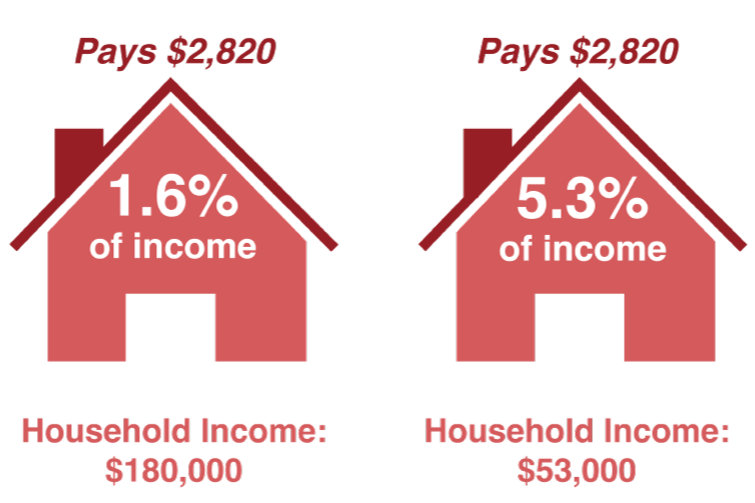
This unfair and unnecessary tax will hit households earning less than their neighborhood’s median income the hardest. Since the tax will be based on an area’s median income, it will eat up a much larger portion of a working-class household’s earnings than those of a wealthy family in the same neighborhood or city. This could devastate hardworking Utahns who are already living paycheck to paycheck.
This tax is gigantic relative to a typical water rate increase. A standard water rate increase might be a 3–5% increase in the cost of the water bill. But since your income is much larger than your monthly water bill, a water rate increase based on 3% of your neighborhood’s income is much larger. This tax is effectively an income tax increase, and it is a radical overreach by big government.

Stay Informed.
Get updates about the campaign to stop the tax.